





Sacred Textiles Of The Andes:
Stories, Symbols, And Meaning
Published April 15, 2025
Reading time: 4 minutes
By Lesia Tello & Jordy Munarriz
In the highlands of the Andes, cloth is never just cloth.
For centuries, Andean weavers have threaded their worldview into textiles—crafting not only warmth or beauty, but meaning. These sacred textiles are stories, maps, prayers, and codes passed from one generation to the next. In every pattern lies a memory. In every color, a message.
To touch a woven cloth in the Andes is to trace the outlines of a worldview—one shaped by mountains, ancestors, and stars. Textiles carry what words cannot: a language of gesture, balance, and cosmic rhythm.
This Earth Month, we turn our gaze to these ancient threads—not for what they sell, but for what they tell. Because in the Andes, to weave is to remember. And to wear is to speak.
Textiles as Living Narratives
Long before books or alphabets arrived in the Andes, there were stories—woven in thread. Andean textiles have long served as visual scripts. Through color, shape, and structure, they communicate genealogy, cosmology, and territory [1]. The weft and warp are not simply functional—they hold direction, rhythm, and memory.
Unlike Western writing systems, which separate word from material, Andean weavings are their message. “Textiles,” writes Andrea Heckman, “can be read like texts, telling stories of ancestors, myths, and places” [2].
The quipu, an Inca system of knotted cords, is perhaps the clearest example of how thread became language. These cords documented census data, agricultural inventories, and possibly even poetic expression [3]. Though not “read” in the alphabetic sense, they were touched, counted, and understood—bridging memory and governance.
Today, in remote communities, the practice of storytelling through cloth continues. Each thread spun by hand, each pattern selected, carries the voice of elders, the imprint of mountains, and the legacy of a people whose history was never written in ink—but in wool.

Picture by: Marco Alhelm
Relatedcontent

10 Practices from Cusco That Celebrate Harmony with Nature

Wool Rethinking Outdoor Gear

Rethinking Livestock-Based Textiles For A Greener Future
In the highlands of the Andes, cloth is never just cloth.
For centuries, Andean weavers have threaded their worldview into textiles—crafting not only warmth or beauty, but meaning. These sacred textiles are stories, maps, prayers, and codes passed from one generation to the next. In every pattern lies a memory. In every color, a message.
To touch a woven cloth in the Andes is to trace the outlines of a worldview—one shaped by mountains, ancestors, and stars. Textiles carry what words cannot: a language of gesture, balance, and cosmic rhythm.
This Earth Month, we turn our gaze to these ancient threads—not for what they sell, but for what they tell. Because in the Andes, to weave is to remember. And to wear is to speak.
Textiles as Living Narratives
Long before books or alphabets arrived in the Andes, there were stories—woven in thread. Andean textiles have long served as visual scripts. Through color, shape, and structure, they communicate genealogy, cosmology, and territory [1]. The weft and warp are not simply functional—they hold direction, rhythm, and memory.
Unlike Western writing systems, which separate word from material, Andean weavings are their message. “Textiles,” writes Andrea Heckman, “can be read like texts, telling stories of ancestors, myths, and places” [2].
The quipu, an Inca system of knotted cords, is perhaps the clearest example of how thread became language. These cords documented census data, agricultural inventories, and possibly even poetic expression [3]. Though not “read” in the alphabetic sense, they were touched, counted, and understood—bridging memory and governance.
Today, in remote communities, the practice of storytelling through cloth continues. Each thread spun by hand, each pattern selected, carries the voice of elders, the imprint of mountains, and the legacy of a people whose history was never written in ink—but in wool.
Picture by: Marco Alhelm
Sacred Symbols Woven in Cloth
To understand Andean textiles, you must understand their symbols.
Animals are more than motifs; they are protectors and teachers. The serpent represents wisdom, the puma strength, and the condor vision and spiritual elevation. These are not decorations—they are guides.
Geometric symmetry in textiles reflects the Andean principle of yanantin, or sacred duality—day and night, male and female, earth and sky. Balance is not an aesthetic preference, but a cosmic necessity [4].
Colors, too, speak. The red of cochineal dye signifies life force and ceremony; black, the fertile womb of Pachamama; yellow, the sacred sun (Inti). A textile is a multidimensional language—one you wear across your shoulders or wrap around your children.

A contemporary Andean textile featuring the Chakana (Andean cross) surrounded by serpent motifs—symbols of knowledge, balance, and spiritual power.
Rituals and Offerings: When Cloth Becomes Ceremony
In the Andes, weaving is not just labor—it’s ritual.
From births to burials, textiles accompany every life passage. A newborn is wrapped in a lliqlla to receive ancestral protection. A bride is gifted woven belts symbolizing union and prosperity. And when someone passes, textiles are buried with them, returning with them to the earth [2].
The loom itself is sacred. Many weavers in Cusco and Puno begin by making offerings to the land, to the Apus (mountain spirits), asking for permission to harvest wool or plant dye herbs [5]. The act of weaving can be meditative, almost prayerful—each motion invoking continuity between the human and the divine.
Sometimes, textiles are not worn but offered. In pagos a la Pachamama, small woven cloths are placed on the earth along with coca leaves, maize, and chicha. These are not symbolic gestures—they are sacred contracts [4]. They renew balance, express gratitude, and call for harmony between humans and their living environment.

Traditional Andean lliqlla woven from camelid hair, featuring bird and floral motifs in ceremonial patterns. This textile illustrates the aesthetic and spiritual dimensions of indigenous Andean weaving. Picture by: The Metropolitan Museum of Art
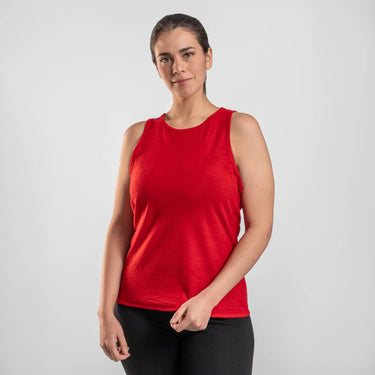
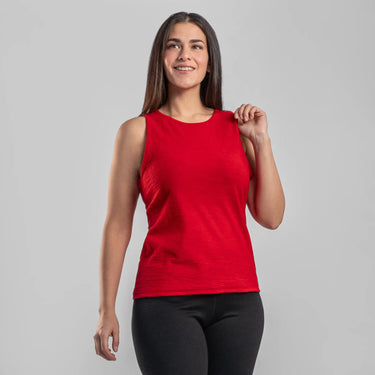
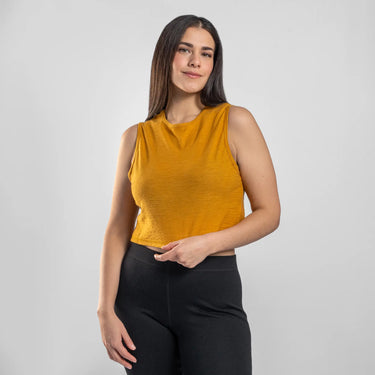
At Arms of Andes we make our gear from 100% Royal Alpaca Wool of 18-18.5 microns.

Men's Alpaca Wool Tank Top 160 Ultralight

Women's Alpaca Wool Hiking T-Shirt 160 Ultralight Relaxed Fit

Women's Alpaca Wool Leggings 300 Lightweight
Sacred Symbols Woven in Cloth
To understand Andean textiles, you must understand their symbols.
Animals are more than motifs; they are protectors and teachers. The serpent represents wisdom, the puma strength, and the condor vision and spiritual elevation. These are not decorations—they are guides.
Geometric symmetry in textiles reflects the Andean principle of yanantin, or sacred duality—day and night, male and female, earth and sky. Balance is not an aesthetic preference, but a cosmic necessity [4].
Colors, too, speak. The red of cochineal dye signifies life force and ceremony; black, the fertile womb of Pachamama; yellow, the sacred sun (Inti). A textile is a multidimensional language—one you wear across your shoulders or wrap around your children.
A contemporary Andean textile featuring the Chakana (Andean cross) surrounded by serpent motifs—symbols of knowledge, balance, and spiritual power.
Rituals and Offerings: When Cloth Becomes Ceremony
In the Andes, weaving is not just labor—it’s ritual.
From births to burials, textiles accompany every life passage. A newborn is wrapped in a lliqlla to receive ancestral protection. A bride is gifted woven belts symbolizing union and prosperity. And when someone passes, textiles are buried with them, returning with them to the earth [2].
The loom itself is sacred. Many weavers in Cusco and Puno begin by making offerings to the land, to the Apus (mountain spirits), asking for permission to harvest wool or plant dye herbs [5]. The act of weaving can be meditative, almost prayerful—each motion invoking continuity between the human and the divine.
Sometimes, textiles are not worn but offered. In pagos a la Pachamama, small woven cloths are placed on the earth along with coca leaves, maize, and chicha. These are not symbolic gestures—they are sacred contracts [4]. They renew balance, express gratitude, and call for harmony between humans and their living environment.
Traditional Andean lliqlla woven from camelid hair, featuring bird and floral motifs in ceremonial patterns. This textile illustrates the aesthetic and spiritual dimensions of indigenous Andean weaving. Picture by: The Metropolitan Museum of Art
Weaving Meaning, Wearing Memory
In every warp and weft, there is history. In every pattern, a purpose.
Andean textiles are not static artifacts or bohemian souvenirs. They are living systems of knowledge, shaped by ecology, mythology, and memory [6]. The designs may shift, the dyes may change, but the essence remains: to weave is to preserve, to protect, and to pass down.
They teach patience. They teach listening. They require one to slow down, to observe the sky, the seasons, the elders, the land.
It’s about respecting the meaning behind what we wear. And that means listening—to the women weaving at 4,000 meters above sea level, to the symbols that have guided generations, to the threads that continue to speak.
This Earth Month, let’s honor the knowledge woven into every sacred thread.

Picture by: Yuri Rodriguez Rodriguez .
Glossarykeywords
Apu:
A sacred mountain spirit in Andean cosmology, believed to protect and guide surrounding communities.
Chakana:
Also known as the Andean cross, this symbol represents the three realms of existence: the upper world (Hanan Pacha), middle world (Kay Pacha), and underworld (Uku Pacha).
Chicha:
A traditional fermented corn drink used in rituals and celebrations.
Lliqlla:
A rectangular woven cloth traditionally used by Andean women to carry children or goods; also part of ceremonial attire.
K'intu:
A ceremonial arrangement of three coca leaves, often used in rituals to express gratitude and intention.
Unku:
A traditional woven garment used in rituals or offerings, symbolizing respect and sacred intent.
Yanantin:
A key Andean concept of sacred duality and complementary balance (e.g., male/female, night/day, mountain/valley).
Weaving Meaning, Wearing Memory
In every warp and weft, there is history. In every pattern, a purpose.
Andean textiles are not static artifacts or bohemian souvenirs. They are living systems of knowledge, shaped by ecology, mythology, and memory [6]. The designs may shift, the dyes may change, but the essence remains: to weave is to preserve, to protect, and to pass down.
They teach patience. They teach listening. They require one to slow down, to observe the sky, the seasons, the elders, the land.
It’s about respecting the meaning behind what we wear. And that means listening—to the women weaving at 4,000 meters above sea level, to the symbols that have guided generations, to the threads that continue to speak.
This Earth Month, let’s honor the knowledge woven into every sacred thread.
Picture by: Yuri Rodriguez Rodriguez .
Authors & Researchers

Lesia tello
Biologist and hiking enthusiast with a deep admiration for nature and the intricate mechanisms of life. With a background in biochemistry and a master’s degree in education, she blends science with adventure, exploring how we interact with the natural world and sharing insights on outdoor experiences.

Lesia tello
Biologist and hiking enthusiast with a deep admiration for nature and the intricate mechanisms of life. With a background in biochemistry and a master’s degree in education, she blends science with adventure, exploring how we interact with the natural world and sharing insights on outdoor experiences.

Jordy Munarriz
Environmental Engineer with a master’s degree in renewable energy and a specialization in sustainability. A passionate traveler and advocate for responsible tourism, he captures the essence of exploration through storytelling, inspiring others to connect with nature in a conscious and meaningful way.

Glossarykeywords
Apu:
A sacred mountain spirit in Andean cosmology, believed to protect and guide surrounding communities.
Chakana:
Also known as the Andean cross, this symbol represents the three realms of existence: the upper world (Hanan Pacha), middle world (Kay Pacha), and underworld (Uku Pacha).
Chicha:
A traditional fermented corn drink used in rituals and celebrations.
Lliqlla:
A rectangular woven cloth traditionally used by Andean women to carry children or goods; also part of ceremonial attire.
K'intu:
A ceremonial arrangement of three coca leaves, often used in rituals to express gratitude and intention.
Unku:
A traditional woven garment used in rituals or offerings, symbolizing respect and sacred intent.
Yanantin:
A key Andean concept of sacred duality and complementary balance (e.g., male/female, night/day, mountain/valley).

References:
[1] Cabrera Altieri, D. H. (2022). El imaginario textil: una interpretación alternativa en los estudios de la comunicación. History of Media Studies, 2.
[2] Heckman, A. M. (2003). Woven stories: Andean textiles and rituals. UNM Press.
[3] Araya, M. J. R. (2024). Textiles, Techniques, Technologies: Exploring Post-Ancestrality and Contemporary Practices. «Technology and language»(Технологии в инфосфере), 5(3), 106-121.
[4] Arnold, D. Y. (2018). The Andean material world. In K. S. Fine-Dare & L. J. Seligmann (Eds.), The Andean World (pp. 142–154). Routledge.
[5] Angeles Falcón, R. (2020). Intertwining the past and the present through textiles, experiences in the communities, a vision from Peru.
[6] Greenlee, G. (2016). Sacred Currency: The Value of Textile in Colonial Andean Painting.