

Fiber
What is a micron in wool clothing?
Wool clothing is usually classified by microns (μm). If you wonder what exactly it means and how it defines the fiber quality and price, let's find out with us.
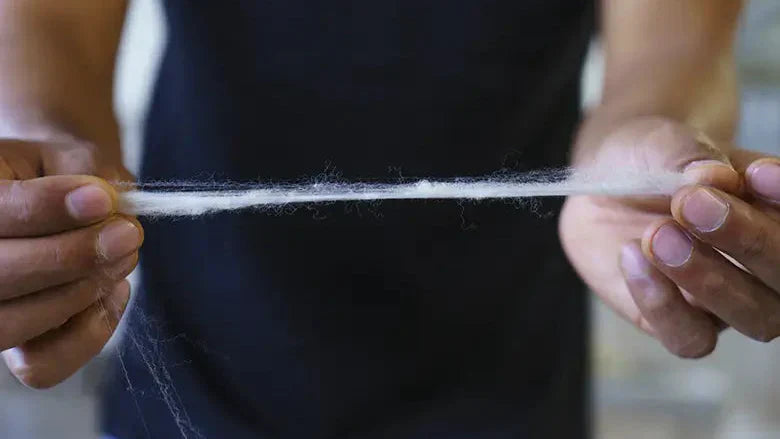
What is a micron in wool?
In the world of natural fibers, the term "micron" plays a fundamental role in determining softness, performance, and quality. A micron (µm) is a unit of measurement equal to one millionth of a meter (1 µm = 0.000001 m), used to quantify the diameter of individual fibers. In textile science, finer fibers (lower micron count) generally feel softer and are more suitable for next-to-skin garments. However, coarser fibers may offer increased durability and structure—important in outerwear or hard-wearing clothing.
- Finer fibers (lower micron values) generally feel softer and more luxurious against the skin.
- Coarser fibers (higher micron values) are typically more durable and insulating.
This measurement is critical in evaluating the comfort, function, and cost of garments made from natural animal fibers [1]
How micron affects comfort and performance
The diameter of a fiber directly influences:
- Softness: Finer fibers bend more easily, reducing irritation on the skin. Fibers under 20 μm are considered soft enough for next-to-skin wear [2].
- Insulation: Coarser fibers trap more air due to their thickness and structure, increasing thermal insulation.
- Durability: Thicker fibers are more resistant to abrasion and mechanical stress [3].
Thus, the fiber micron is not just a marketing label—it has technical implications for garment performance.
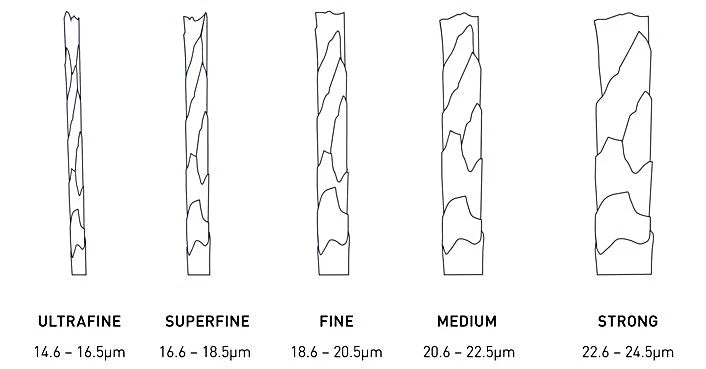
What do different diameters mean?
- Human hair: 50-100 microns
- Alpaca wool: 18-18.5 microns
- Merino wool: 20-23 microns
- Cashmere: 14-16 microns
In the textile industry, microns of 20 and above are usually used for outer layer clothes such as wool sweaters, jumpers, scarves, or wool blankets [1]. However, this does not mean that fibers below 20 microns cannot be used for outer layers. You can find alpaca wool jumpers and merino wool sweaters of less than 20 microns. Because of the way the garment is knitted, the garment can still provide a great amount of warmth while being naturally lightweight. But due to their delicate nature, the merino market uses 20 microns or more.
Typically, fibers of 20 microns and below are used for garments next to skin, such as wool base layers, super base layers, underwear, socks, tank tops, etc.
Adapted image. Source: Woolmark.
What is the difference in touch?
The tactile experience of wearing alpaca or merino wool can vary depending on several key factors: fiber diameter (micron count), fiber structure, and the way the garment is knitted or woven [2,3,4]. Both alpaca and merino wool are prized for their softness, but they achieve this in slightly different ways: Fiber Fineness and Softness Finer fibers—those with a lower micron count—feel softer against the skin and are less likely to cause itching or irritation, making them ideal for next-to-skin wear. The softer the wool, the more luxurious and gentle the touch, which is particularly important for babies, people with sensitive skin, or those living in warm climates. Durability vs. Softness Thicker fibers (higher micron count) may feel slightly coarser, but they tend to be more durable and insulating—ideal for outerwear and long-lasting garments. Finer fibers are softer but may require more delicate care. The Role of Knitting or Weaving As important as fiber is, the construction method of the garment significantly affects the final feel:
- Tighter knits can make a garment feel denser and warmer, even if made with fine wool.
- Looser knits or lightweight weaves increase breathability and drape, giving the garment a softer, airier touch.
What is the difference in price?
The price of wool products is primarily influenced by the fineness of the fiber, measured in microns. The lower the micron, the finer, softer, and more luxurious the wool—and the higher its market value [4].
Finer wool = higher cost
Producing garments from fine alpaca or ultrafine merino wool requires:
- Careful sorting of the fleece to isolate only the finest fibers.
- Slower, more delicate spinning and processing to preserve the softness.
- Smaller yield per animal, since only certain parts of the fleece meet high-quality standards (e.g., baby alpaca comes from the softest part, not necessarily from a young animal).
All of this results in higher production costs, which translates to a higher retail price —but also a softer, more breathable, and skin-friendly garment.
Coarse wool = lower cost
On the other hand, wool with a higher micron count (thicker fibers) is:
- More abundant and easier to process.
- Often used in bulk textiles, outerwear, or durable utility garments.
- Faster and cheaper to manufacture, as it doesn’t require the same delicate handling.
However, thicker fibers tend to feel itchier or rougher, especially when worn directly on the skin, making them less suitable for luxury or babywear.
Choosing garments based on micron count is more than a matter of softness—it's about understanding your performance needs. Alpaca wool provides an ideal balance of comfort, durability, and thermoregulation.
At Arms of Andes, we work with 100% Alpaca wool. No blends. No plastic. No greenwashing.
[[1] IWTO. IWTO Wool Notes 2024. International Wool Textile Organization. 2024. Available from:https://iwto.org/wp-content/uploads/2024/06/IWTO-Wool-Notes-2024.pdf
Sources (3)
- Wortmann FJ, Wortmann G, Haake HM, Eisfeld W. Analysis of the torsional storage modulus of human hair and its relation to hair morphology and cosmetic processing. J Cosmet Sci. 2014 Mar/Apr;65(2):59–68.
- Holman BWB, Malau‑Aduli AEO. A review of sheep wool quality traits. Annu Res Rev Biol. 2012 Jan;2(1):1–14.
- Doyle EK, Preston JWV, McGregor BA, Hynd PI. The science behind the wool industry: the importance and value of wool production from sheep. Anim Front. 2021 Mar;11(2):15–23. doi:10.1093/af/vfab005


