


Trail
Alpaca wool for extreme weather | sustainable high performance gear
Alpaca wool: a natural fiber for extreme weather
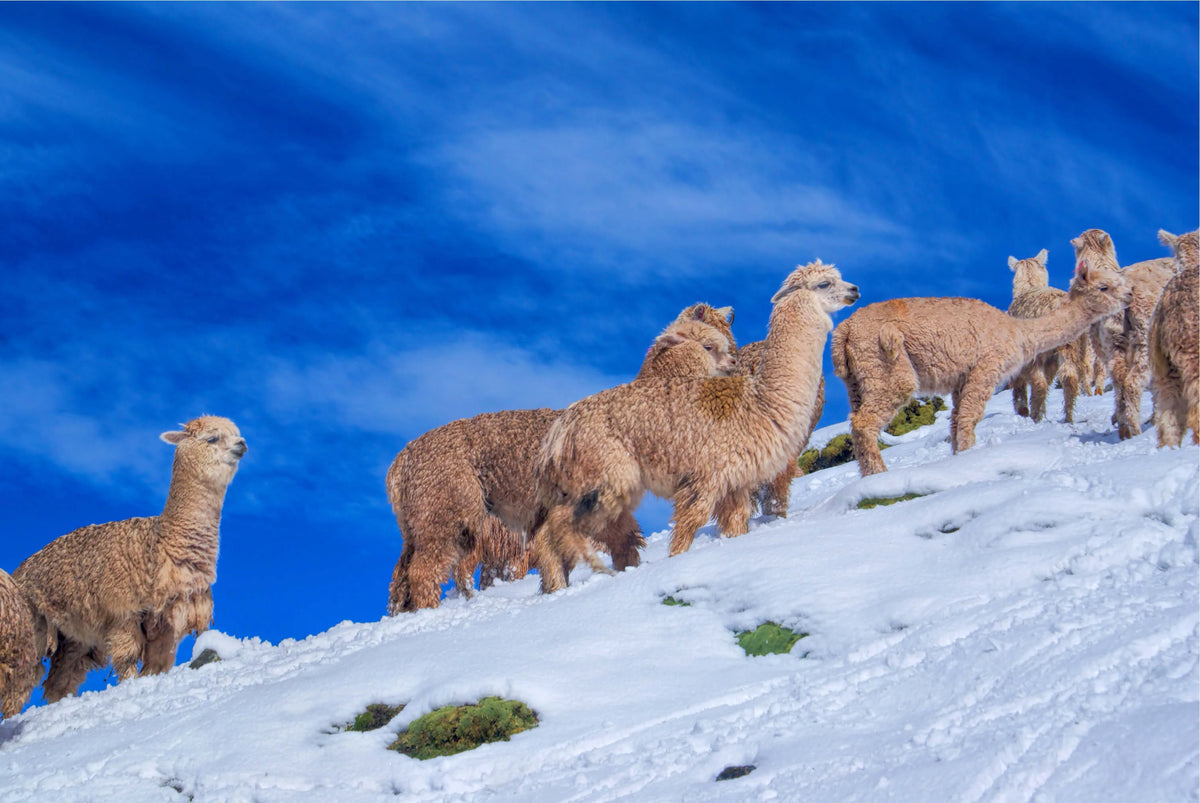
High in the Andes, one of the world’s most demanding environments, alpacas have thrived for thousands of years. At altitudes often exceeding 3,500 meters, the Andes present an unforgiving mix of scorching solar radiation during the day, freezing temperatures at night, and sudden winds that can shift conditions in minutes. In this climate, survival depends on adaptation and the Alpaca’s wool is its most vital defense.

The science behind Alpaca fiber
Alpaca wool is more than just a natural material—it is a biological engineering masterpiece shaped by the extreme environment of the Andes. At the molecular level, Alpaca fibers are composed primarily of keratin, a structural protein also found in human hair and nails. Keratin’s arrangement in Alpaca wool creates a balance between flexibility, durability, and thermal performance, making the fiber naturally resilient to both cold and heat variations [1,2,3]
Semi-hollow core structure
One of the most distinctive features of Alpaca wool is its semi-hollow core, which differentiates it from fibers like Merino. The hollow spaces trap microscopic layers of air, functioning as an insulating barrier. This mechanism is similar to double-pane glass: the air pockets reduce heat transfer, keeping warmth close to the body in cold conditions while preventing overheating in high solar radiation [1,4,5,6].
Fiber diameter and softness
Alpaca fibers range between 16 –25 microns, depending on the animal’s age and breed. Finer fibers are comparable in softness to cashmere, while slightly thicker fibers provide additional durability. Unlike sheep’s wool, Alpaca lacks lanolin, the greasy coating that can trap allergens and odors, making Alpaca naturally hypoallergenic [1,7].
Breathability and moisture management
Beyond insulation, Alpaca fibers have a unique hydrophilic-hydrophobic balance: they can absorb up to 30% of their weight in moisture without feeling wet, while simultaneously wicking excess sweat away from the skin. This dual property prevents clamminess during intense physical activity and protects the body from chill once temperatures drop [1].
UV protection
Another critical property of Alpaca wool is its natural resistance to ultraviolet radiation. Darker fibers contain higher concentrations of melanin, which absorb harmful UV rays, while lighter fibers reflect solar radiation, reducing surface heat load. [8,9,10]. This makes Alpaca garments highly functional in high-altitude settings where UV exposure is intense—such as the Andes or the Alps.
Thermal regulation in extreme cold
Alpaca wool is renowned for its exceptional thermal insulation. The fiber’s semi-hollow core traps microscopic air pockets, creating a natural barrier that reduces heat transfer between the body and the environment. This mechanism allows Alpaca garments to preserve body heat even in sub-zero conditions without requiring bulky layers [6,7].
Comparative studies on animal fibers demonstrate that Alpaca exhibits lower thermal conductivity than Merino and Cashmere, meaning it retains warmth more efficiently at equivalent weights [1]. Alpaca fibers offer superior thermal insulation per unit weight, confirming its advantage in cold climates [8,11,12].
Breathability and heat management in high sun exposure
While excellent in cold conditions, Alpaca wool is equally effective in managing heat under intense solar exposure. Its fiber structure allows moisture vapor to escape, preventing overheating and maintaining comfort during physical exertion. This breathability ensures that body temperature remains stable even under direct sun.
Alpaca also provides natural ultraviolet (UV) protection. Alpaca wool of similar weight and density can exhibit 10–20% higher Ultraviolet Protection Factor (UPF) compared to Merino, due to its longer fibers and higher melanin concentration in darker colors [11,13]. In practice, this means Alpaca clothing offers significant protection in high-altitude regions like the Andes or arid deserts where UV radiation is extreme.
Odor resistance and hygiene in multi-day use
One of the most practical benefits of Alpaca wool in expeditions is its resistance to odor. The fiber’s antibacterial properties inhibit the growth of odor-causing bacteria, unlike synthetic fibers that tend to retain unpleasant smells after a single day of use [1,14].
On the other hand, McQueen and Vaezafshar (2012) demonstrated that wool fibers (including Alpaca) retain less odor compared to polyester, thanks to their moisture absorption and keratin-based structure [15]. This makes Alpaca ideal for multi-day hikes or expeditions where frequent washing is not possible, allowing it to be worn repeatedly without losing its freshness and reducing the need to carry multiple changes of clothes.
Skin-friendly properties in harsh environments
Unlike sheep’s wool, Alpaca contains minimal lanolin, a waxy substance that can irritate sensitive skin [16]. This makes Alpaca naturally hypoallergenic and an excellent choice for individuals prone to eczema, dermatitis, or skin rashes.
In demanding environments where sweat, friction, and rapid temperature changes are constant, Alpaca wool remains gentle on the skin. Its smooth fiber scales create a softer surface, reducing chafing during high activity compared to coarse wools or synthetics [1,6,7]
| Property | Alpaca Wool | Merino Wool | Synthetic Fibers |
|---|---|---|---|
| Thermal insulation (cold) | Excellent (hollow core) | Very good | Moderate, depends on thickness and and its processing |
| Breathability (heat) | High | Medium-high | Low (traps heat) |
| UV protection | Very high (UPF 25–50+) | High (UPF 20–40) | Variable (polyester = high) depends on its processing |
| Odor resistance | Excellent | Good | Poor |
| Moisture management | Absorbs and dries slowly but regulates | Absorbs well | Repels but traps sweat |
| Skin-friendliness | Hypoallergenic | Can cause irritation (lanolin) | Risk of rashes, non-breathable |
| Sustainability | Biodegradable | Biodegradable | Microplastic shedding |
Sustainability
Beyond performance, Alpaca wool offers sustainability advantages that remain crucial in extreme environments. Unlike synthetic fibers that shed microplastics, Alpaca is 100% biodegradable [1]. This ensures that garments do not contribute to long-term environmental pollution when exposed to outdoor wear and eventual disposal.
Additionally, alpacas have a lower ecological footprint compared to sheep or goats. They graze without uprooting grasses, preserving soil integrity in high-altitude ecosystems [17]. Their water requirements are minimal, making Alpaca herding naturally adapted to the arid Andean climate. In contrast, Merino sheep farming has been linked to higher land degradation and greater methane emissions [18].
From a textile perspective, Alpaca fibers require less chemical processing, as they naturally resist odors and bacteria. This reduces the need for harsh chemical finishes (such as superwash treatments) commonly applied to other wools [19,20].

Conclusion
Alpaca wool is more than a traditional Andean fiber—it is a natural high-performance material uniquely suited for extreme conditions. Compared to Merino and other fibers, Alpaca consistently demonstrates higher insulation efficiency, greater UV protection, and enhanced comfort for sensitive skin. Beyond performance, its ecological footprint is remarkably low: biodegradable and sourced from animals that harmonize with fragile ecosystems.
At Arms of Andes, we believe performance and sustainability don’t need to be opposites—they can come from the same place: nature. Every hoodie, base layer, or t-shirt we create is made from 100% Alpaca wool, crafted in Peru, and designed to respect your body and the environment. No synthetics. No blends. Just natural performance trusted for centuries in the Andes.
The mountains shaped Alpaca wool to overcome every challenge. Let it help you overcome yours.
Sources (21)
- Woolmark.
- Holt C. Alpaca myths, or are they? New Zealand Alpaca. Aug 2016. https://www.thenaturalfibre.co.uk/sites/default/files/files/Aug2016_6_AlpacaMythsOrAreThey.pdf
- Fortunati E, Aluigi A, Armentano I, Morena F, Emiliani C, Martino S, Santulli C, Torre L, Kenny JM, Puglia D. Keratins extracted from Merino wool and Brown Alpaca fibres: thermal, mechanical and biological properties of PLLA based biocomposites. Mater Sci Eng C Mater Biol Appl. 2015 Feb;47:394–406. doi:10.1016/j.msec.2014.11.007. PMID: 25492212. https://pubmed.ncbi.nlm.nih.gov/25492212/
- Holmer I. Protective clothing in hot environments. Ind Health. 2006;44(3):404-13.
- Allain D, Renieri C. Genetics of fiber production and fleece characteristics in small ruminants, Angora rabbit and South American camelids. Animal. 2010;4(9):1472–1481. doi:10.1017/S1751731110000029.
- Radzik-Rant A., Pofelska O., Rant W. Characteristics of Alpaca wool from farmed animals located on different continents. Annals of Warsaw University of Life Sciences - SGGW. Animal Science. 2018;57(2):151-158. DOI 10.22630/AAS.2018.57.2.15. Available from: https://agro.icm.edu.pl/agro/element/bwmeta1.element.agro-ecf2a896-4e5f-46b7-a22d-8d3752fab74f
- Radzik-Rant A, Wiercińska K. Analysis of the wool thickness and medullation characteristics based on sex and color in a herd of alpacas in Poland. Arch Anim Breed. 2021;64(1):157–165. doi:10.5194/aab-64-157-2021. Available from: https://aab.copernicus.org/articles/64/157/2021/
- Alpaca Information. Alpaca fiber characteristics [Internet]. [cited 2025 Sep 4]. Available from:https://www.alpacainfo.com/academy/article/4562/alpaca-fiber-characteristics
- Moore K. The impact of fleece characteristics on insulation and heat exchange, and the consequential effect on vitamin D of alpacas in southern Australia [dissertation]. Perth (AU): The University of Western Australia; 2015.
- Allain D, Renieri C. Genetics of fibre production and fleece characteristics in small ruminants, Angora rabbit and South American camelids. Animal. 2010 Sep;4(9):1472-81. doi: 10.1017/S1751731110000029
- Gawish SM, Helmy HM, Ramadan AN, Farouk R, Mashaly HM. UV Protection Properties of Cotton, Wool, Silk and Nylon Fabrics Dyed with Red Onion Peel, Madder and Chamomile Extracts. J Textile Sci Eng. 2016;6(4):1000266. doi:10.4172/2165-8064.1000266.
- Czyż K, Wyrostek A, Wojdon A, Jankowska D. Selected physical and mechanical properties of Alpaca fibers differing in color. J Nat Fibers. 2024;21(1). doi:10.1080/15440478.2024.2348626 https://www.tandfonline.com/doi/full/10.1080/15440478.2024.2348626
- D. Rama Rao; V. b. Gupta. (1992). Thermal characteristic of wool fibers Journal of Macromolecular Science - Physic, B31(2), 149-162.
- Holmer I. Protective clothing in hot environments. Ind Health. 2006;44(3):404-13.
- Ivankovic T, Rajic A, Ercegovic Razic S, Rolland du Roscoat S, Skenderi Z. Antibacterial properties of non-modified wool, determined and discussed in relation to ISO 20645:2004 standard. Molecules. 2022 Mar 14;27(6):1876. doi:10.3390/molecules27061876. Pmid: 35335238; pmcid: pmc8950207. https://pmc.ncbi.nlm.nih.gov/articles/PMC8950207/
- McQueen RH, Laing RM, Delahunty CM, Brooks HJL, Niven BE. Odor retention on apparel fabrics: Development of test methods for sensory detection. Textile Research Journal. 2007;77(9):645–652. doi:10.1177/0040517507078792. https://www.researchgate.net/publication/200550273_Odor_Retention_on_Apparel_Fabrics_Development_of_Test_Methods_for_Sensory_Detection
- National Center for Biotechnology Information. Lanolin. PubChem Compound Summary [Internet]. [cited 2025 Sep 4]. Available from:https://pubchem.ncbi.nlm.nih.gov/compound/Lanolin
- Gómez Oquendo G, Salazar‑Cubillas K, Alvarado V, Gómez‑Bravo CA. Estimation of carbon footprint and sources of emissions of an extensive Alpaca production system. Trop Anim Health Prod. 2022;54(5):331. doi:10.1007/s11250-022-03271-y. https://alpaca.asn.au/wp-content/uploads/2022/10/GomezOquendo_etal_2022_alpaca_carbon_footprint.pdf
- Food and Agriculture Organization of the United Nations. Grassland of the world. In: Land and Water Digital Media Series. FAO; 2005 [cited 2025 Sep 4]. Available from:https://www.fao.org/4/y8344e/y8344e0a.htm
- Holt, R. R. D. (1975). Introduction to superwash wool. Journal of the Society of Dyers and Colourists, 91(2), 38–44.
- Farm Fiber Knits. (2024). What is the superwash process and what does it do to wool? Farm Fiber Knits. https://farmfiberknits.com/what-is-the-superwash-process-and-what-does-it-do-to-wool/


